 Holy Bible Online
Gamaliel was a highly respected rabbi, a teacher of the Law, and a member of the Sanhedrin in the first century. He became known for his wisdom and great influence among the Jews. The Bible presents him as Paul's teacher before the apostle's conversion and as the man who advised the Sanhedrin not to persecute the followers of Jesus.
A descendant of the school of Hillel, Gamaliel was regarded as one of the greatest teachers of Judaism. He trained many scholars of the Law, including Saul of Tarsus, who would later become the apostle Paul. Although he is not presented as a follower of Jesus, Gamaliel demonstrated prudence and respect for God's sovereign work. Another Gamaliel appears in the Bible, a leader of the tribe of Manasseh during the time of Moses (Numbers 1:10), but he is not connected to Paul's teacher.
The best-known moment of Gamaliel's story took place during a meeting of the Sanhedrin when the apostles were arrested for preaching the gospel. While many of the leaders wanted to put them to death, Gamaliel warned that if the movement was of human origin, it would disappear on its own. But if it was from God, no one would be able to stop it, and the leaders might find themselves fighting against the Lord Himself.
In addition to his role in the Sanhedrin, Gamaliel is forever linked to the story of Paul. Years after Christ's resurrection, the apostle himself declared that he had been educated "at the feet of Gamaliel," receiving rigorous training in the Law of Moses. This foundation later enabled Paul, after his conversion, to understand the Scriptures more deeply and proclaim that Jesus was the promised Messiah.
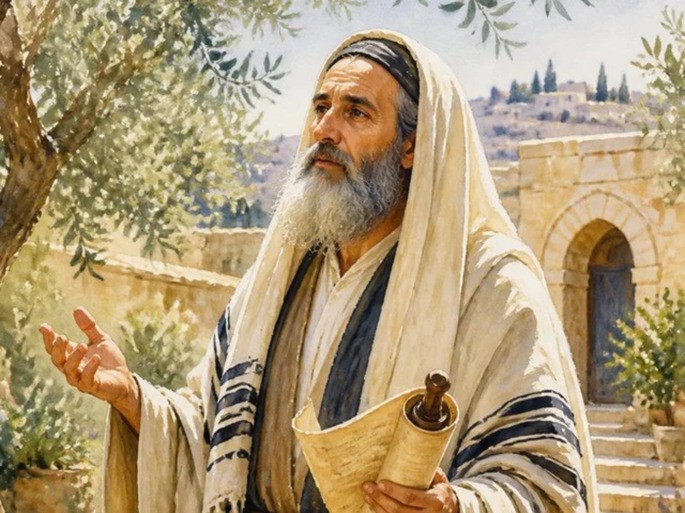
Even though he appears only a few times in the Bible, Gamaliel left an example of wisdom and prudence by recognizing that God might be accomplishing a new work. His attitude teaches us the importance of acknowledging that the Lord directs history according to His will.
Bible Study on Gamaliel
The Relationship Between Gamaliel and Paul
Before coming to know Jesus, Paul was known as Saul of Tarsus. He was an extremely zealous Pharisee who persecuted the early Christians, believing he was defending the true Jewish faith.
Much of this knowledge was acquired during the years he studied under Gamaliel. Paul's thorough understanding of the Law explains both the depth of his letters and his ability to engage with Jews and scholars of the Scriptures alike.
After his conversion, Paul did not abandon this knowledge. Instead, he used it to demonstrate that all the promises of the Old Testament found their fulfillment in Jesus Christ.
Although Gamaliel and Paul ultimately followed different paths, the training the future apostle received was later used to spread the gospel throughout the Roman Empire.
Learn more about the story of the Apostle Paul.
"At the Feet of Gamaliel": What Does It Mean?
When Paul was arrested in Jerusalem, he declared before the crowd:
I am a Jew, born in Tarsus of Cilicia, but brought up in this city. I studied under Gamaliel and was thoroughly trained in the law of our ancestors. I was just as zealous for God as any of you are today.
- Acts 22:3 (NKJV)
The expression "at the feet of Gamaliel" was a way of saying that Paul had been a direct disciple of this renowned teacher. In Jewish tradition, students learned by sitting at the feet of their rabbi, listening carefully to his instruction and absorbing his teachings.
To study at the feet of Gamaliel meant receiving an exceptionally high-quality education. Paul was thoroughly trained in the Scriptures, the interpretation of the Law, and Jewish traditions by one of the greatest teachers of his generation.
Later, after encountering Jesus on the road to Damascus, Paul would use all this knowledge to demonstrate from the Scriptures that Christ was the Messiah foretold by the prophets.
Gamaliel's Advice to the Sanhedrin
One of the best-known events involving Gamaliel in the Bible occurred when the apostles were arrested for proclaiming the resurrection of Jesus. Many members of the Sanhedrin were furious and wanted to put them to death immediately.
Gamaliel asked that the apostles be taken outside for a short time. He then reminded the religious leaders that other movements had arisen in the past, such as those led by Theudas and Judas the Galilean. Both had gathered followers, but their movements disappeared after the deaths of their leaders. Based on these examples, Gamaliel offered a principle of remarkable wisdom:
Therefore, in the present case I advise you: Leave these men alone! Let them go! For if their purpose or activity is of human origin, it will fail. But if it is from God, you will not be able to stop these men; you will only find yourselves fighting against God.
- Acts 5:38-39 (NIV)
This advice persuaded the Sanhedrin not to execute the apostles. Instead, they were flogged and ordered not to continue preaching. Even so, they continued proclaiming the gospel.
Gamaliel's words reveal an important truth: no one can stop what God has determined to accomplish. Throughout history, many have tried to silence the message of Christ, yet the gospel has continued to spread throughout the world, just as Gamaliel had warned.
Did Gamaliel Become a Christian?
The Bible does not state that Gamaliel became a Christian. Even so, his attitude toward the apostles demonstrates balance and respect for the possibility that God was at work.
While other leaders were driven by anger and sought to eliminate Jesus' followers, Gamaliel chose to wait and allow God Himself to reveal the truth of the matter.
His example teaches us that important decisions should not be made based solely on emotion. Sound judgment, discernment, and a willingness to recognize God's work remain essential qualities for those who desire to live according to His will.
What Can We Learn from the Life of Gamaliel?
Gamaliel's life shows that knowledge and wisdom must go hand in hand. He had an exceptional mastery of the Law, yet he did not use that knowledge to judge others hastily or to consider himself superior.
During the persecution of the apostles, he demonstrated that decisions made in the heat of anger often lead to injustice. The advice he gave to the Sanhedrin remains just as relevant today: a work that is merely human will eventually fade away, but what comes from God cannot be stopped.
Gamaliel also reminds us that great teachers leave a lasting legacy. By training Paul, he helped prepare one of the greatest proclaimers of the gospel, even though the two ultimately followed different paths. He influenced others through reasoned argument and dialogue rather than through violence.
Finally, his story shows that God uses people in a variety of circumstances to accomplish His purposes. His example encourages us to examine every situation in the light of God's Word before taking action, rather than opposing what the Lord may be doing.
See Also: