 Holy Bible Online
There were two kings named Jeroboam in Israel. Jeroboam I was a servant of Solomon and became the first king of the Northern Kingdom after the division of Israel. Despite his leadership, he ended up instituting the worship of golden calves. Jeroboam II ruled later, expanded the borders, and brought prosperity, but he also remained distant from God. Sadly, both promoted idolatry, leaving a legacy of unfaithfulness to the Lord.
Jeroboam I was the first king of the Northern Kingdom (Israel) after the division of Solomon’s united kingdom. According to the Bible, he was the son of Nebat, from the tribe of Ephraim, and his mother was named Zeruah, a widow.
It is worth noting that Jeroboam was not the brother of Rehoboam nor the son of Solomon; Rehoboam belonged to the tribe of Judah and reigned over the Southern Kingdom (Judah).
Jeroboam began as a servant of Solomon, standing out for his administrative ability. The prophet Ahijah the Shilonite announced to him that God had chosen him to rule over ten tribes of Israel because of Solomon’s idolatry. After Solomon’s death, Jeroboam returned from Egypt, where he had gone into hiding, and was proclaimed king by the northern tribes, while Rehoboam retained Judah and Benjamin.
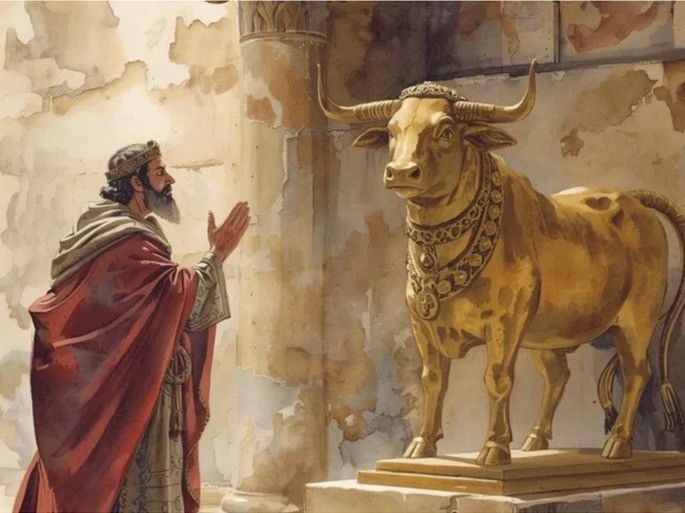
Fearing that the people would return to Jerusalem to worship and thus support Rehoboam, Jeroboam I created two golden calves, placing one in Bethel and the other in Dan, and declared, “Here are your gods, O Israel.” He also appointed priests who were not Levites and established his own religious calendar. These decisions turned Israel away from the worship of the Lord and became a lasting symbol of idolatry for the generations that followed.
His wife is not named in the Bible, but it is known that he had a son named Abijah (or Abijam), who became ill. When she consulted the prophet Ahijah, he announced the child’s death and the future disaster of Jeroboam’s household because of his sins.
Jeroboam I reigned for about 22 years, facing conflicts with Rehoboam and his son Abijah, king of Judah. He died and was succeeded by his son Nadab. His legacy was one of disobedience and idolatry: the expression “the sins of Jeroboam son of Nebat” became a biblical reminder of how the spiritual deviation of a leader can corrupt an entire nation.
Bible Study on Jeroboam I
The sins of Jeroboam I
The sins of Jeroboam I, according to the Bible (1 Kings 12–14), refer mainly to idolatry and direct disobedience to God. After becoming king of the Northern Kingdom, he feared that the people would return to Jerusalem to worship at the temple and thus support Rehoboam, king of Judah. To prevent this, Jeroboam created two golden calves, spreading the worship of images.
Jeroboam I also appointed priests who were not Levites, contrary to the law of Moses, and created his own religious calendar, with festivals different from those ordained by God. These actions corrupted true worship and led the entire nation into idolatry. He also did not repent, even after the prophet Ahijah announced God’s judgment on his house.
The phrase “the sins of Jeroboam son of Nebat” became a recurring expression in the books of Kings, describing the pattern of idolatry followed by nearly all the kings of Israel.
Jeroboam’s sin was replacing the worship of the Lord with idolatrous practices, leaving a legacy of unfaithfulness that deeply marked Israel’s spiritual history.
Nadab, son of Jeroboam I
Nadab was the son of Jeroboam I and the second king of the Northern Kingdom (Israel), as recorded in 1 Kings 15:25–31. He ascended the throne after his father’s death and reigned for only two years in Samaria.
He followed the same sins as Jeroboam I, continuing the worship of the golden calves and keeping the people in idolatry, far from the worship of the true God.
During his reign, Nadab fought against the Philistines and besieged the city of Gibbethon, which belonged to Judah. It was there that Baasha, one of his officials, conspired against him and killed him. After the assassination, Baasha took the throne and exterminated all the descendants of Jeroboam I, thus fulfilling the prophecy of the prophet Ahijah, who had foretold the end of Jeroboam’s house because of his sins. Nadab is remembered as a short-reigning, unfaithful king who showed no repentance.
What we learn from Jeroboam I
The story of Jeroboam I teaches profound lessons about leadership, faith, and obedience to God. He began with a great opportunity: he was chosen by God to reign over ten tribes of Israel.
Instead of trusting God, Jeroboam acted out of fear and insecurity, fearing that he would lose power if the people returned to worship in Jerusalem. This lack of trust led him to idolatry, creating golden calves and turning the heart of the nation away from God.
From this we learn that disobedience, even when driven by political or personal intentions, never pleases God. When we place security, success, or human approval above faithfulness to Him, we open the door to error.
Jeroboam also shows that a leader’s decisions have collective consequences: his idolatry influenced generations and became a constant negative example in Scripture.
His story warns us to value obedience, humility, and faith. Trusting God, even when the path seems uncertain, is always the wisest choice. Thus, Jeroboam I reminds us that power and achievements are temporary, but faithfulness to God leaves an eternal legacy.
The story of Jeroboam II
Jeroboam II was the son of Jehoash, king of Israel (the Northern Kingdom), and belonged to the dynasty of Jehu. He reigned in Samaria for about 41 years (2 Kings 14:23–29), making him one of the longest-reigning and most prosperous rulers of the Northern Kingdom.
His reign marked a period of political stability and economic growth. Jeroboam II managed to restore Israel’s former borders and recover territories that had been lost to Syria. Under his leadership, the country experienced prosperity and security, as had been foretold by the prophet Jonah, son of Amittai.
However, material abundance was not accompanied by spiritual renewal. During his rule, practices of idolatry and social injustice persisted. The prophets Amos and Hosea denounced the excessive luxury of the powerful, the exploitation of the poor, and the false religiosity that dominated the people. Although Israel prospered outwardly, its distance from God grew inwardly.
After the death of Jeroboam II, the kingdom entered a rapid decline. The apparent strength achieved during his reign proved fragile in the face of corruption and lack of spiritual faithfulness. Just a few decades later, Israel was conquered by Assyria in 722 BC.
Jeroboam II is remembered as a king who brought prosperity and expansion to the Northern Kingdom, but whose period of glory was overshadowed by the moral and spiritual decay of the people.
See also:
- Kings of Israel and Judah: Who the 43 Kings were and their Characteristics
- The story of Rehoboam (son of Solomon and grandson of David)
- Who Was King Solomon in The Bible And 11 Main Facts About His Life
- Bible Characters: List of People In The Bible And Their Stories
- Who Were the Prophets in the Bible?